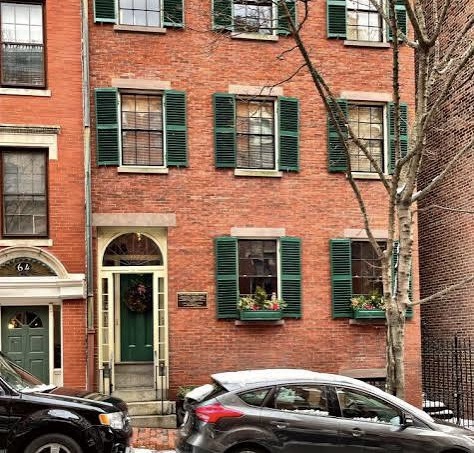
Beacon Hill’s north slope has a rich history of African American heritage that continues to shape the neighborhood’s housing patterns, economic landscape, and built environment. This project examines how 66 Phillips Street, known as the Lewis Hayden House, has had a lasting impact on preservation efforts that influence Beacon Hill today with profound significance. Constructed in 1833, this Greek Revival Row House shown above (Figure 1), has stood as a symbol of resistance and community. Through research on this property, we uncover a crucial piece of social and ethnic heritage, exploring how architecture and spatial organization reflected and reinforced community resilience, resistance, and identity. This paper argues that Hayden’s use of his home blurred the boundaries between private space and political actions, making the built environment central to Boston’s abolitionist movement.
Beacon Hill and African American Heritage
Beacon Hill has served as an important hub for abolitionist and civil rights activism. The African Meeting House, the Abiel Smith school among other Black institutions and specific individuals, like Lewis Hayden, played a significant role in the abolitionist movement. These also included buildings associated with the Underground Railroad that served as key sites of resistance and have undergone transformations over time. Hayden used his home to protect freedom seekers and their fight for freedom, challenging the way cities were built and who they were built for. Hayden’s story shows how everyday spaces can spark bigger changes in cities, shaping a more just and equitable future.
Architecture of 66 Phillips Street
Before delving into a historical analysis of 66 Phillips Street, we must first examine its physical characteristics. This property was listed as a Local Historic District in 1995, a National Register District in 1962 and finally a National Historic Landmark in 1962. MACRIS describes the site as a mansard Townhouse, which is known as a type of urban row house that features a distinctive mansard roof. A mansard roof is a roof with two slopes on each side, where the lower slope is steeper and often punctuated by dormer windows. The home is a rectangular building that rises three stories tall and three bays wide, constructed of red brick with a brownstone trim. At the front of the property is a short walkway with steps made from granite. The entryway was “originally very open, but today it is partially enclosed by narrow Colonial Revival multi-pane sidelights and a rectangular transom containing a semi-circular fanlight”(MACRIS). Above the front door, there’s a rectangular brownstone block that is called a lintel that sits on top of a transom window. A transom window is just a small window meant to let in light. The windows on the building have raised stone sills underneath and stone lintels on top that sit flush with the wall. The windows themselves are the classic 6-over-6 style which means each window has two panes with six small glass sections each, framed by wooden shutters with slats that are called louvered shutters. At the top of the front of the building, there’s a simple decorative brick trim that is called a cornice. Due to the architectural elements being rather common in Beacon Hill, the property’s significance lies more with the history of its use by the Hayden’s family, rather than for architectural significance, however notable.
Lewis Hayden: From Enslavement to Abolitionist
Lewis Hayden was born enslaved in Lexington, Kentucky, around 1811. Over the course of three decades, he experienced the horrors of slavery. Hayden lived a fairly long time for the era, passing at 79 years old in April of 1889. Using Census data, at the time of Hayden’s death, the average life expectancy was 44 years old. This disparity was even greater for African Americans, due to systemic racism and unequal access to healthcare, housing and economic opportunity. Hayden’s early life was defined by family separation. During Hayden’s enslavement, he had met a woman, his first wife named Esther Harvey and had a son. Hayden sadly was never able to see or find them again after they were sold to a Kentucky politician named Henry Clay. By 1842, Hayden chose to be remarried to a woman named Harriet Ann Adams. Harriet gave birth to a son, Joseph, and they escaped to freedom around 1844. While in the couple’s pursuit for freedom, they ended up having another child, Elizabeth, where they soon settled in Boston. Around Elizabeth’s fifth birthday, it was reported she had died due to unknown circumstances.
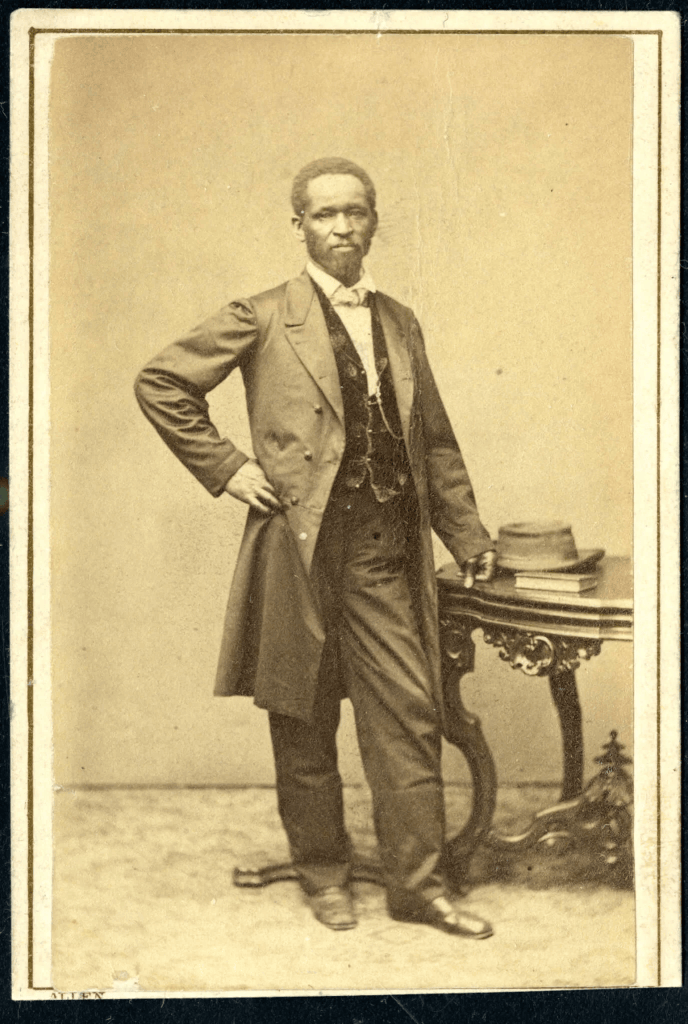
Figure 2 – Lewis Hayden, NPS.
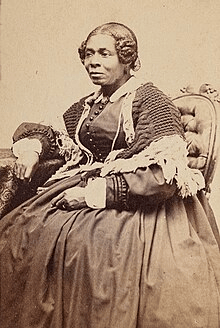
Figure 3 – Harriet Hayden, NPS.
Hayden had taught himself to read using hidden Bibles and newspapers, demonstrating intellectual curiosity as well as being politically driven. These characteristics would prove to make him very successful in order to purchase their home on Beacon Hill. A Boston leather merchant named Milton Gale played a pivotal role in guiding the Hayden’s escape from slavery in Kentucky. Once in Boston, Hayden became a prominent businessman and established a successful clothing store on Cambridge Street in Beacon Hill, which provided financial stability for their families livelihood and cover for his abolitionist work while providing a platform to engage in political activism.
The Hayden House and the Underground Railroad
Between 1850-1860s, Hayden served as a vital figure in Boston’s Underground Railroad network. He held several roles in the abolitionist movement and served on the executive committee of the Boston Vigilance Committee. Beginning in the late 1830s, Boston abolitionists had begun using Faneuil Hall to host all their meetings and rallies. It was through these extensive meetings, the community came together to form “vigilance committees to assist those seeking freedom on the Underground Railroad, encouraging supporters to help those in need and thwart slave catches” (NPS). While on this committee, Hayden and his family’s home became a meeting place for abolitionists and a safe house for those seeking freedom from enslavement. The home’s location within a tightly knit Black activist community was ideally situated for collective action and mutual support of abolitionist efforts. The home functioned as a literal safe haven and shelter for those in desperate need.
Through Hayden’s continued support for the abolitionists and violating the Fugitive Slave Law, put him and his family into precarious and dangerous situations. The home became a ‘strategic stronghold’ serving as a meeting place in the community. The Fugitive Slave Law of 1793 stated “no Person held to Service or Labour in one State, under the Laws thereof, escaping into another, shall, in Consequence of any Law or Regulation therein, be discharged from such Service or Labour, but shall be delivered up on Claim of the Party to whom such Service or Labour may be due” (NPS). In order to ease some tensions between the northern and southern states, The Fugitive Slave Law of 1850 was updated during a series of actions by the government known historically as the Compromise of 1850. This ‘compromise’ included a stricter Fugitive Slave Law to appease pro-slavery interests. This law required that runaway slaves be returned to their enslavers without a fair trial, with cases decided by federal commissioners who were financially incentivized to rule in favor of returning the individuals. Federal marshals were given authority to enforce the law, and state and local authorities, even private citizens, were required to assist. Those who obstructed this law, like Hayden, were subject to hefty fines and jail time. Creating an atmosphere of fear and especially legal jeopardy for those who supported the cause. The Hayden’s, like many Bostonians, did not morally take kindly to the updated Fugitive Slave Laws and began to further organize movements acting against the government in order to support their fellow African Americans.
The William and Ellen Craft Escape
During the early 1850s we are introduced to William and Ellen Craft, a couple who came to Boston and escaped slavery with the aid of Lewis Hayden. Hayden had provided the couple with lodging when they arrived in the city among other needs. They spoke at many anti-slavery meetings in Boston and shared the same stage with prominent historical figures like Frederick Douglass and William Lloyd Garrison. William Craft recalled, “One night… Lewis Hayden and I had a keg of gunpowder under his house in Phillips Street [formerly Southac Street], with a fuse attached ready to light should any attempt be made to capture us” (NPS). As chaos unfolded and slave catchers were on the hunt for William and Ellen, they ultimately failed to apprehend the individuals as they progressed closer to freedom and ran further from slavery. The Craft family undoubtedly owed their lives to all those who aided and risked their own safety for the better good of their freedom. After spending almost a year in hiding and running in Boston, by December of 1850 the Crafts had successfully fled to Halifax, Nova Scotia, Canada and not too long after made the move to England.
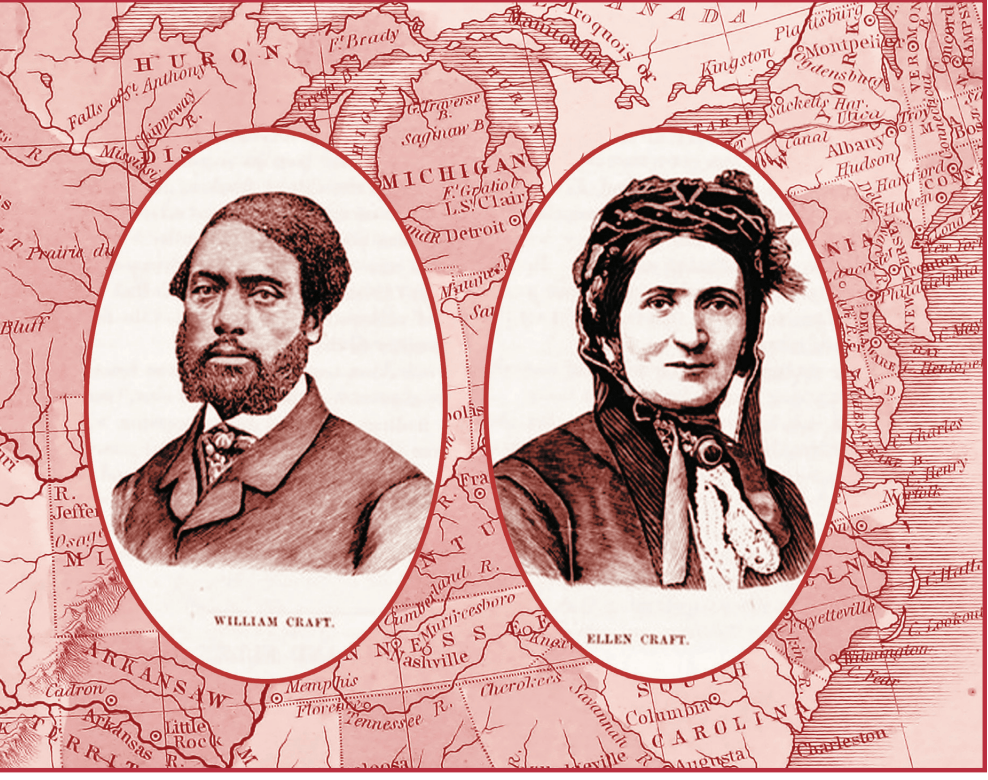
Figure 4 – William and Ellen Craft, NPS.
It was in England where the Crafts continued to speak out against slavery while building their new life together, having five children. About ten years later, the Crafts decided to tell the world their harrowing story in a published narrative titled Running a Thousand Miles for Freedom; Or the Escape of William and Ellen Craft from Slavery. Ellen and William Craft represent thousands of enslaved peoples’ stories and the efforts taken to help these individuals by people like Lewis Hayden. A figure that the Craft’s considered their hero among other notable figures in African American history located on the North slope of Beacon Hill.
The Legacy of Lewis and Harriet Hayden
By 1873, Lewis Hayden, with even more prominence in the community, was elected as a Massachusetts state legislator, not long before his death in 1889. After Lewis passed, Harriet followed him in 1893. The home continued to serve the community after their passing. Harriet gave their entire estate to Harvard Medical School for the creation of the “Lewis and Harriet Hayden Scholarship for Colored Students,” a fund that still exists today. The Hayden’s are buried next to each other located at Woodlawn Cemetery in Everett, MA. 66 Phillips Street continued to serve as a boarding house for African Americans, including former slaves, during the late 19th and early 20th centuries. Specific details about the occupants during this period are limited. The house was later designated as a site on the Black Heritage Trail and became part of the Boston African American National Historic Sites. Included in Lewis Hayden’s legacy is a project in the U.S. Postal Service initiated in 2024. The USPS designed 10 unique stamps with courageous men and women who were celebrated for guiding enslaved people to freedom using the Underground Railroad before the Civil War.
Preservation and the Lewis Hayden House Today
According to the Boston Tax Assessor’s website, 66 Phillips street was sold to a man named John Gier in 1984 for $252,500 and today is now valued at $2.4 million. Adjusted for inflation, the home would be about $800,000, yet due to the significance of Beacon Hill, property prices have skyrocketed since the early 2000s. John and his wife Mary were asked to sign and uphold a contract with the National Parks Service that stated the couple would not alter the facade of the property.Included in this document is a memorandum of understanding that the property is indeed historically significant with the Museum of Afro-American History, and all efforts must be used to preserve the historical significance. John and Mary agreed and signed the contract. The couple, still today, live on the first floor of the property and serve as landlord to the two other available and rentable units on site. All of the units have been refurbished in the last 2 years and retain minimal significance to their original indoor appearance.

Figure 5 – John and Mary Gier with their dog Gretchen, Tufts.
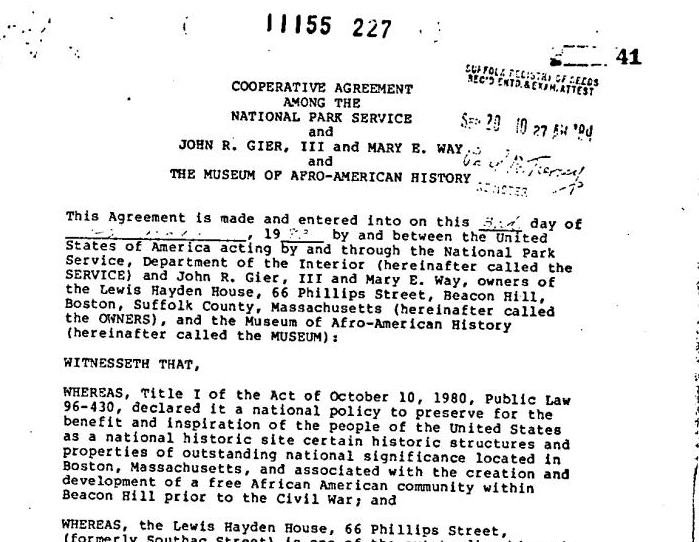
Figure 6 – NPS Agreement, MACRIS.
Conclusion
Though today, it remains a private residence and is not open to the public, it is honored by the community which continues to inspire historical reflection on our past, inspiring continued activism. The Lewis Hayden House is more than an architectural and historic relic, it is a monument to resistance, community solidarity, and the struggle for freedom. 66 Phillips Street exemplifies how everyday buildings can become epicenters of political resistance. From its physical structure, which offered sanctuary, to the people who brought it to life with meaning and bravery, the house represents how built spaces can shape and reflect social movements. Preservation of this site ensures that Hayden’s story and the broader story of Beacon Hill’s African American community will continue to inspire future generations striving for justice and equity.
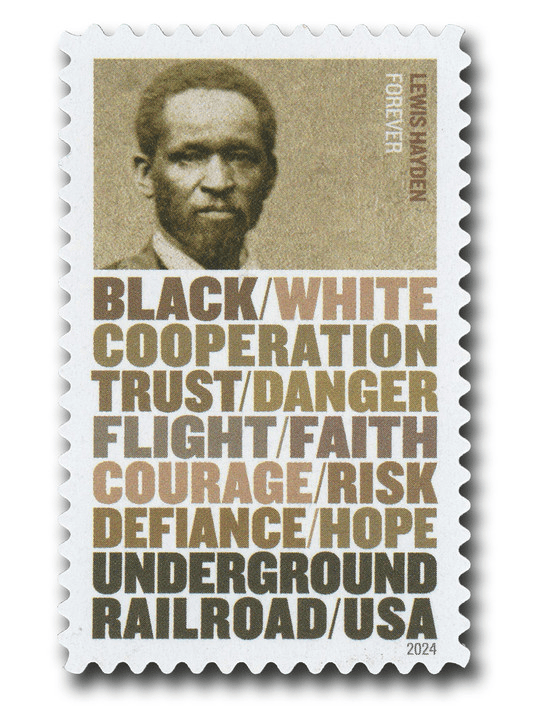
Figure 7 – U.S. Postal Service commemorative stamp, U.S Postal Service.
Works Cited
City of Boston. Property Assessment: Parcel 0502067000. Accessed May 1, 2025. https://www.cityofboston.gov/assessing/search/?parcel=0502067000.
Craft, William, and Ellen Craft. Running a Thousand Miles for Freedom: Or, The Escape of William and Ellen Craft from Slavery. London: William Tweedie, 1860.
Cummings School of Veterinary Medicine. Annual Appeal Sample. Annual Giving Network, n.d. https://annualgivingnetwork.com/wp-content/uploads/gravity_forms/44-3a76f61f84a24a0370e98582b9f44de9/2021/06/StephanieM_CummingsVeterinary_AppealSample.pdf.
Harvard Medical School. Lewis Hayden. Perspectives of Change. Accessed May 1, 2025. https://perspectivesofchange.hms.harvard.edu/node/9.
Leventhal Map & Education Center. Atlascope Boston. Accessed April 13, 2025. https://atlascope.leventhalmap.org/.
Massachusetts Archives. Lewis Hayden. Accessed May 1, 2025. https://www.sec.state.ma.us/divisions/commonwealth-museum/download/Lewis-Hayden.pdf.
Massachusetts Historical Commission. MACRIS: 66 Phillips Street (BOS.5457). Accessed April 23, 2025. https://mhc-macris.net/Details.aspx?MhcId=BOS.5457.
National Constitution Center. The Fugitive Slave Act (1850). Accessed April 23, 2025. https://constitutioncenter.org/the-constitution/historic-document-library/detail/the-fugitive-slave-act-1850.
National Park Service. Boston African American National Historic Site. Accessed May 1, 2025. https://www.nps.gov/boaf/index.htm.
National Park Service. Fugitive Slave Laws in Boston. Last updated February 28, 2023. https://www.nps.gov/articles/000/fugitive-slave-laws-boston.htm.
National Park Service. Harriet Hayden. Last updated March 1, 2024. https://www.nps.gov/people/harriet-hayden.htm.
National Park Service. Lewis Hayden. Last updated February 29, 2024. https://www.nps.gov/people/lewis-hayden.htm.
United States Postal Service. U.S. Postal Service Remembers Shining Beacons of the Underground Railroad. News release. February 9, 2024. https://about.usps.com/newsroom/national-releases/2024/0209ma-usps-remembers-shining-beacons-of-the-underground-railroad.htm.
 Echoes of a Home
Leave a comment